
Better Decisions Require More Than Accurate Data.
Across governments, public health programmes, development organisations, and research institutions, decisions increasingly rely on complex, interconnected datasets. Yet data that appears accurate may still be incomplete, inconsistent, poorly governed, or unsuitable for the decision at hand.
RDQA (Rohitah Data Quality Assurance) helps organisations move beyond traditional data validation by assessing whether data is truly fit for its intended purpose. Combining deterministic quality assessment, AI-assisted diagnostics, and human-centred governance, RDQA strengthens confidence in the decisions built upon data.
 Data Quality Diagnostics
 Decision Confidence
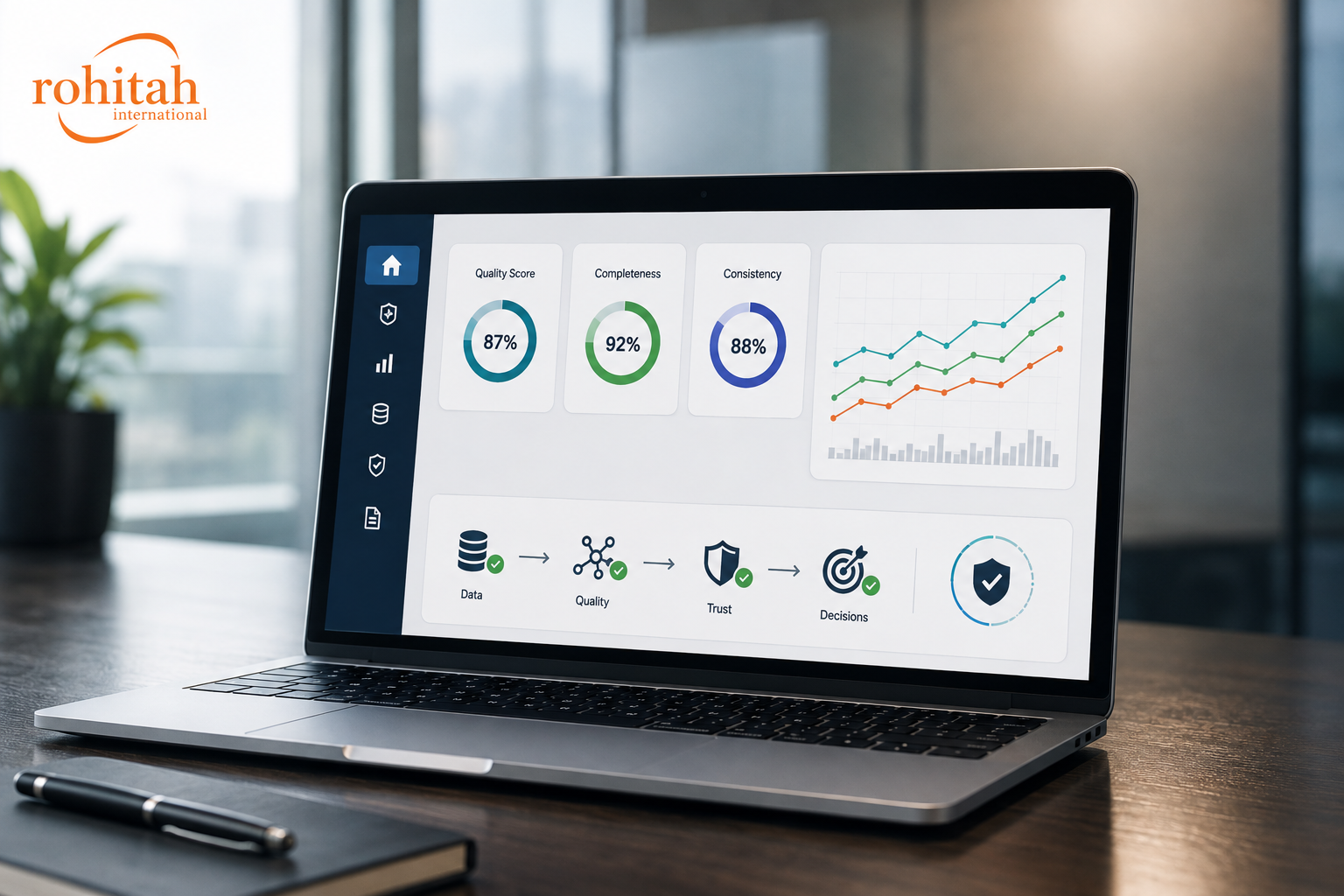
Most data quality systems focus on identifying errors, validating indicators, or generating compliance reports. While these activities remain important, they often answer only one question:
Traditional Question"Is the data technically correct?"
Decision-Maker's Question"Can this data be trusted for this specific decision?"
The answer depends on much more than accuracy. It requires confidence in completeness, consistency, interoperability, governance, traceability, and contextual relevance. RDQA was created to bridge this gap.
Rather than measuring data quality alone, RDQA evaluates whether data is sufficiently trustworthy to support informed, transparent, and accountable decision-making.
RDQA is built on three guiding principles.
The ultimate objective of data quality is not cleaner datasets—it is better decisions.
Responsible AI enhances diagnostic capability by identifying patterns, detecting anomalies, and generating structured insights. Human experts remain responsible for governance, interpretation, and final decision-making.
Every assessment should be transparent, reproducible, and auditable. Confidence cannot be delegated to a black-box algorithm.
RDQA strengthens every stage between data collection and decision-making.
Traditional Systems Ask
Is the data complete?
RDQA Asks
Is the data complete enough for this decision?
Traditional Systems Ask
Are validation rules satisfied?
RDQA Asks
What risks remain despite passing validation?
Traditional Systems Generate
Quality Scores
RDQA Generates
Decision Confidence
Traditional Systems
Identify errors.
RDQA
Explains how those errors influence decision fitness.
RDQA evaluates data through eight independent quality dimensions. Together, they provide a multidimensional understanding of decision readiness rather than a single composite score.
Assess whether datasets are technically prepared for reliable use.
Determine whether sufficient information exists to support meaningful interpretation.
Evaluate logical consistency across variables, indicators, and records.
Compare multiple data sources to identify agreement, discrepancies, and integration risks.
Assess consistency across reporting periods, geographical areas, and comparative analyses.
Evaluate whether observed patterns are realistic within their operational context.
Assess whether available evidence is appropriate for the intended decision.
Ensure findings can be traced, verified, and independently reproduced.

RDQA moves beyond simply identifying errors. Every anomaly is classified within a structured diagnostic framework that supports root-cause analysis rather than isolated error reporting.
This enables organisations to understand not only what went wrong, but also:

Responsible AI provides a diagnostic intelligence layer within RDQA. It assists with:
However, AI never replaces governance. Final confidence ratings remain deterministic, transparent, and supported by expert oversight.
RDQA has been designed as a modular platform capable of evolving alongside organisational needs. Future capabilities include:
Every module operates within the same transparent decision assurance framework.
RDQA is designed for organisations where trustworthy data directly influences important decisions.
Strengthen policy decisions through transparent and explainable confidence assessment.
Improve monitoring systems, data governance, and implementation oversight.
Support accountable investments through auditable decision confidence and governance.
Improve confidence in analytical datasets and cross-study data integration.
Integrate configurable decision assurance capabilities through an API-first architecture.
RDQA is currently under active development as part of the Rohitah Solutions portfolio. Development follows an iterative roadmap that combines methodological research, practical implementation experience, and responsible application of artificial intelligence.
AI-assisted diagnostics with expert-configured governance.
Predictive governance and proactive risk identification.
Semi-adaptive optimisation with human-approved rule evolution.
Throughout every stage, deterministic scoring integrity and expert oversight remain central to decision protection.
RDQA is part of Rohitah Solutions, a growing portfolio of evidence systems designed to strengthen data quality, evidence generation, and decision support across research, public health, and development. Every Rohitah Solution is guided by three principles:
Together, these principles ensure that innovation strengthens trust rather than replacing it.
No. RDQA extends beyond conventional DQA by evaluating whether data is appropriate for a specific decision, not simply whether it passes validation rules.
No. Artificial Intelligence enhances diagnostic capability, while governance, scoring, and decision confidence remain transparent, deterministic, and supported by human expertise.
Yes. RDQA has been designed as a modular, API-first platform capable of working alongside existing data collection, analytics, and reporting ecosystems.
In an increasingly complex data ecosystem, organisations need more than validation. They need confidence. RDQA helps organisations understand not only the quality of their data, but also the confidence they can place in the decisions that depend upon it.
Explore RDQARohitah Solutions is an innovation lab for evidence intelligence, designing evidence systems that strengthen data quality, evidence generation, and decision support across research, public health, and development. Powered by responsible AI and grounded in practical implementation experience, each solution addresses a specific challenge while contributing to a shared vision of improving evidence for better decisions.